There was nothing
to equal the determined reticence of Mr. Jaggers. He made a steeple of his
fingers and assumed an air of being in possession of a confidence with which he
was most unwilling to part. Three or four times Mr. Headstone feebly thought he
would start conversation, but on each occasion the lawyer’s basilisk stare
answered him before he could begin. As he sat waiting for the lawyer to speak,
the schoolmaster became acutely cognisant of the passage of time, as marked by
the ticking of the clock on the wall, and the slow adjustment made to the angle
of the sun by the waning afternoon, which he observed through the grimy skylight. It
was but one quarter of an hour before Mr. Jaggers spoke, but to Mr. Headstone
it seemed as if one whole year had passed.
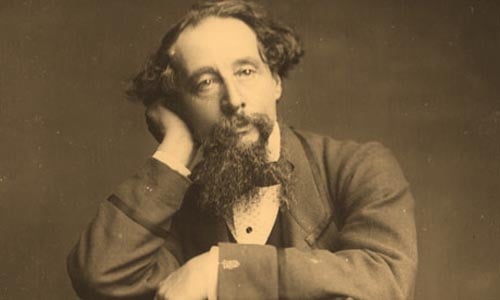
Mr Charles Dickens
Sunday, February 8, 2015
Saturday, February 8, 2014
The Lawyer's Chair
Mr. Jaggers duly sent Mr. Headstone notice of his address, which was in Little Britain, and invited the schoolmaster to call upon him at his own convenience. Being unencumbered by the demands of regular employment, Mr. Headstone determined to pay his respects at the earliest opportunity, and took a hackney-coach to a gloomy street just out of Smithfield. On enquiring at the front office, Mr. Headstone was informed by a clerk that the lawyer was presently in Court, but had left word that any gentleman answering to the name of Headstone was to wait in his room. The clerk was a rather dry man, short in stature, with a square wooden face, whose expression seemed to have been imperfectly chipped out with a dull-edged chisel. He had glittering eyes – small, keen, and black – and thin wide mottled lips. Upon satisfying himself as to the identity of the gentleman before him, this clerk opened a door and ushered Mr. Headstone into an inner chamber at the back. The room was lighted by a skylight only, and was a most dismal place. Mr. Headstone sat down at the lawyer’s desk, opposite a high-backed chair of deadly black horse-hair, with rows of brass nails in it, like a coffin. The schoolmaster did not have to wait long before the owner of that monstrous article of furniture himself appeared and took possession of it. Mr. Jaggers unlocked one of the drawers of his desk and took out some mottled papers. Having satisfied himself with regard to some legal nicety contained within these manuscripts, the lawyer locked them up again like so many convicted felons, and leaned back in his chair. Mr. Headstone, anticipating a revelation, leaned forward in his.

Friday, February 7, 2014
Being the Seventh of February
Mr. Headstone
returned to the metropolis on the morning coach and went directly to his
lodgings. As he had acquainted none of his friends with his decision
to abandon the marsh country, he was obliged to mark the date’s noble anniversary
without company, which, with the aid of a plate of freshly-buttered crumpets
and a pint of gin, he did so much to his own satisfaction.
Monday, February 3, 2014
In Which a Conference is Held by Candlelight
The room in which the conference was held was feebly lighted with one candle. The strange gentleman began by sitting down at the table, drawing the candle to him, and looking over some entries in his pocket-book. He then put up the pocket book and set the candle aside, peering round it into the darkness at Mr. Headstone, who was by now in a state of great expectation. The gentleman introduced himself as a London lawyer by the name of Jaggers, and announced that he had some unusual business to transact with the schoolmaster, for which express purpose he had followed him down into that solitary part of the country. Breaking off in his discourse to examine once again several pages in his pocket-book, the London lawyer at length informed Mr. Headstone that he represented an individual (he would not say whether a man or a woman), who had expressed a most particular interest in the character of the schoolmaster, and wished to procure the services of that same character in return for a handsome emolument. The name of this person was to remain a profound secret, until the person chose to reveal it, and, furthermore, that it was the intention of the person to reveal it at first hand by word of mouth. This was the sole condition of the proposed agreement, and if Mr. Headstone had any objection to it, this was the time to mention it. The schoolmaster having no objection, the London lawyer made a memorandum in his pocket-book, and then enquired when Mr. Headstone could return to London.
Thursday, January 30, 2014
In Which Mr Headstone is Unsettled by a Strange Encounter
The month of January having all but run its course, Mr. Headstone was beginning to despair of something turning up in his favour. In order to avoid the unfortunate circumstance of encountering a creditor (which opportunity the metropolis afforded at every street corner), the schoolmaster had quit the city for the relative solitude of a town in the marsh country on the pretext of visiting an uncle, who was a well-to-do corn-chandler, and drove his own chaise-cart. Of course in this town there was a public house, which went by the name of The Three Jolly Bargemen, and on this particular night, it being particularly cold, the schoolmaster had made himself one of a party assembled around the fire in the bar. As he sat and listened to one of the company read aloud the grisly details of a highly popular murder from the newspaper, Mr. Headstone became aware of a strange gentleman leaning over the back of the settle opposite him, looking on. He had about him an air of authority not to be disputed, and with a manner expressive of knowing something secret about every one of the company, he came into the space between the two settles, in front of the fire, and looked round until all quailed before him. He finally settled his gaze upon the schoolmaster, and, having identified that individual correctly by both name and profession, expressed his desire to have a private conference in an upstairs room, which he had acquired of the landlord for that purpose. Mr. Headstone rose from the settle and followed the stranger in a wondering silence up the stairs.
Tuesday, December 31, 2013
In Which Mr Headstone Makes a Resolution
The time of year
being apposite to the making of resolutions, Mr. Headstone determined to resign
his apprenticeship under Mr. Cruncher, and to look for more congenial employment.
The schoolmaster together with his friends and acquaintances had gathered, as
was their custom, at The Saracen’s Head to
bid farewell to the old year and to welcome in the new. The pot boy was being kept
in a state of perpetual motion, bringing in from the kitchen first some
oysters, and then a pair of roast fowls, together with potatoes boiled and
roasted, followed by a dish of stewed beef with vegetables, and a raised pie
and a dish of kidneys, and then a tart and a shape of jelly, and, last but not
least, the cheese and the celery. Whilst in the execution of these duties, the
pot boy was hailed at regular intervals by members of the party for the
provision of a quart of ale, a pint of champagne, a bowl of gin punch, a round
of sherry cobblers, a flask of brandy, a pint of red wine, and a pint of white,
and various other sundries. Having apprised the company of his present
difficulties, Mr. Headstone was gratified to be in receipt of a number of
suggestions with regard to his future prospects. Mr. Guppy advised him to try
the Bar; Mr. Benjamin Allen and Mr. Bob Sawyer were in favour of the medical
profession; Mr. Richard Swiveller claimed that the life of a jobbing clerk was
not without its attractions. But of all the proffered suggestions he received,
the schoolmaster was most taken with that of Mr. Micawber, who assured him that
if he did nothing but wait, something was bound to turn up.
Monday, December 30, 2013
In Which Mr Headstone is Reunited with a Late Acquaintance
Mr. Headstone and
his two fellow tradesmen began to dig and the sound of their spades at work
echoed around the churchyard. Presently Mr. Cruncher took from the sack an
instrument like a great corkscrew, which he adjusted with a practiced hand.
Whatever tools they worked with, they worked hard, until the awful striking of
the church clock so terrified the schoolmaster that he felt the hairs on his
head and even the bristles on his chin stiffen. He seemed resolved to abandon
his new trade before he had truly begun it, and would have made off that
instant had not his companions assured him that their work was almost done. Mr.
Cruncher dropped down into the opened grave, and there was a screwing and
complaining sound down below before he again emerged. Mr. Headstone took hold
of a length of rope proffered to him, and all three tradesmen pulled.
By slow degrees a great weight broke away
from the earth upon it, and came to the surface. Mr. Headstone very well knew
what it would be; but, when he saw it, and saw Mr. Cruncher about to wrench it
open, he was so frightened, being new to the sight, that his other companion
was obliged to stop his mouth with a quantity of hessian to prevent his cries
from alerting the sexton. The coffin was propped up against the marble stone in
order that Mr. Cruncher could apply his crowbar. This he did with little
ceremony and to the sound of splintering mahogany he forced open the casket’s
heavy lid to reveal the tenant within.
Imagine Mr. Headstone’s surprise when, compelled
by the strangeness of the circumstance to look upon the unfortunate subject of
their labours, he recognised the features to be those of none other than the
late Mr. Merdle. As the departed are beyond the approbation of Society, Mr.
Headstone reasoned that no introductions were necessary, and so he assisted his
companions in removing the gentleman from his state of repose and wrapping him
in a winding sheet. Thus concealed, the body was transported to the gate and by
means of an ingenious system of pulleys hauled over to the other side. The
whole operation was greatly facilitated by the fact that the rigors of death
had taken full effect, and their burden was as easy to carry as a length
of timber.
Before delivering their prize up to two
young medical men, who were desirous of such specimens for the furthering of
their education, the three honest tradesmen went through the corpse’s pockets,
and were rewarded with the discovery of a gold watch, a silver snuff box, and other
sundry items. These spoils were divided up, and Mr. Headstone received as his
share a tortoise shell-handled penknife, which, he reflected, as he walked home
in the early morning light, was a remarkable instance of poetic justice.
Subscribe to:
Comments (Atom)